AI Is Changing Who Can Build Professional Engineering Software
I've spent much of my working life in civil engineering, surveying and software development. Over the years, I've used and developed numerous specialist applications, but I've never experienced anything quite like the transformation currently taking place in software development.
About a month ago, I started an experiment: could modern AI help me develop a fully functional CAD and civil engineering application tailored to my own requirements?
I had attempted something similar about a year earlier, with disappointing results. AI could generate code, but struggled with the complexity and consistency required for a substantial engineering application.
Twelve months later, the difference is remarkable.
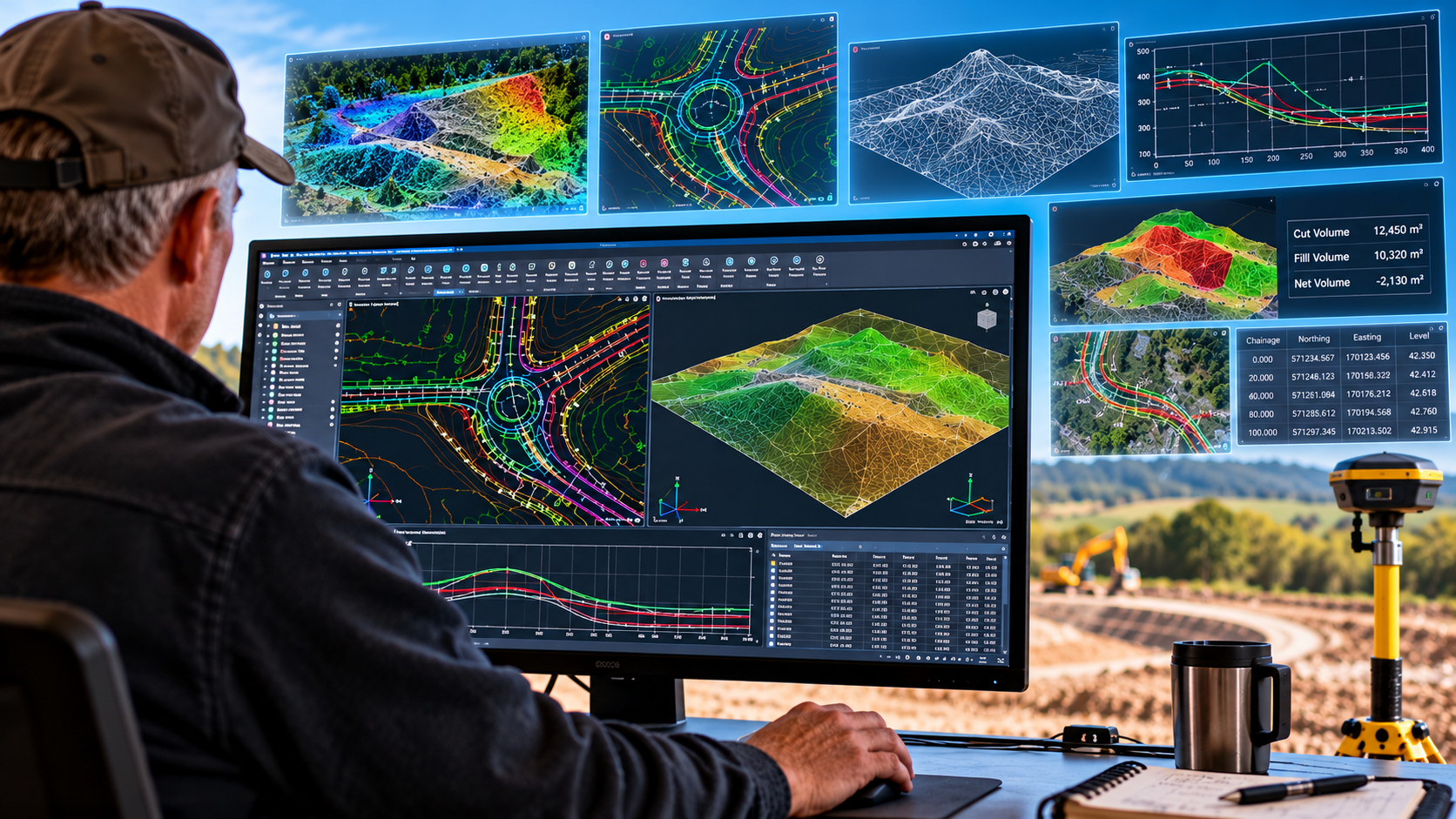
In just a few weeks, I've developed an application incorporating CAD drawing and editing, survey point management, 3D surface triangulation, terrain modelling, volume calculations and specialist road design functions.
Perhaps most impressively, AI can now implement the underlying mathematical algorithms, not merely the user interface. Complex geometric operations that would previously have required considerable development time can now be implemented surprisingly quickly.
Naturally, there are still bugs to resolve, particularly around unusual geometry and unexpected behaviour. However, these are increasingly ordinary software development problems rather than fundamental failures to understand the engineering.
Performance optimisation has also become remarkably straightforward. When a particular operation is slow, AI can often identify and implement significant improvements.
The greatest benefit is the freedom to develop functionality around the way I actually work.
If I encounter a repetitive engineering task, I can create a dedicated command to simplify it. If an existing workflow seems unnecessarily complicated, I can redesign it. Features that might be too specialised to justify inclusion in a mass-market application can be developed specifically for my requirements.
Of course, professional engineering software demands rigorous testing and verification. AI-generated calculations must be checked, and engineering judgement remains essential.
But something fundamental has changed.
Until recently, developing sophisticated professional software required substantial resources, specialist programmers and lengthy development schedules.
Today, an individual with industry experience, programming knowledge and access to modern AI tools can achieve things that would have seemed unrealistic only a short time ago.
The real breakthrough isn't simply that AI can write code. It's that people who understand specialist problems can increasingly create their own solutions.
After just one month, my experiment has already exceeded my expectations.
And given the extraordinary progress AI has made in the past twelve months, I find myself wondering what another year will bring.
Tired of doing this by hand?
Streamtech Setting Out does it automatically, in one click. Free trial, no card needed.
Try Streamtech Setting Out free